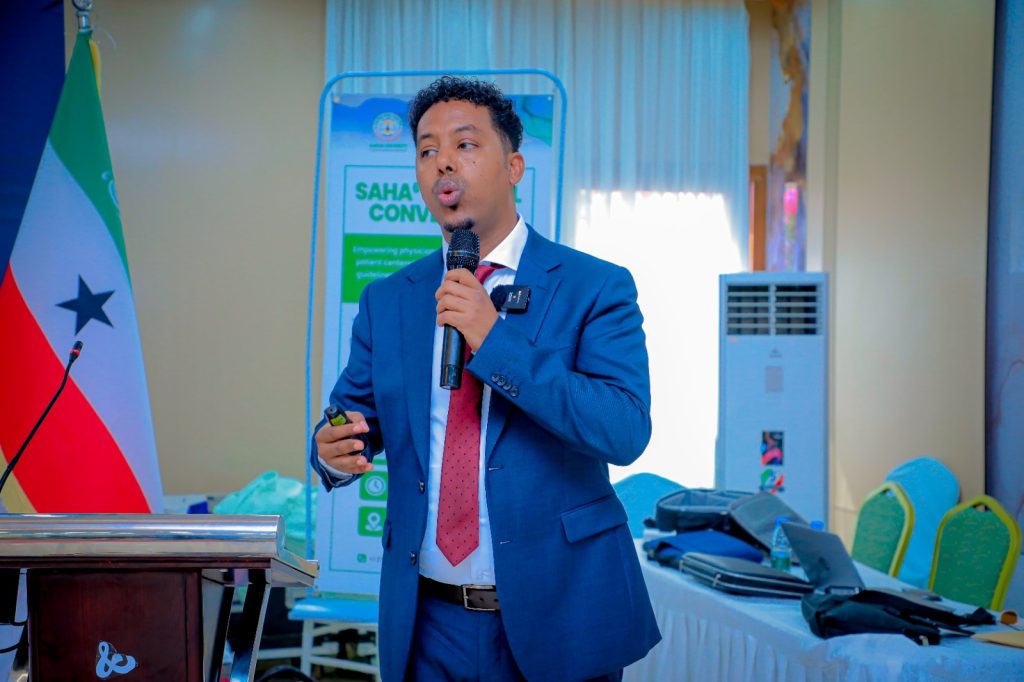
Yusuf Abdi Hared explores the intersection of technology and medicine during the SAHA 2026 convention, highlighting the role of Artificial Intelligence in tackling Non-Communicable Diseases.
BORAMA, Somaliland – As the SAHA 6th Annual CME Convention enters its final sessions, the focus shifted toward the future of medical technology. Yusuf Abdi Hared, a leading Health Epidemiologist, Statistician, and Director of the Center for Community Services, delivered a compelling presentation on a modern frontier: Artificial Intelligence (AI) in healthcare.
With the rising burden of Non-Communicable Diseases (NCDs) such as diabetes, cancer, and chronic respiratory illnesses, Mr. Hared argued that traditional methods must be supported by digital innovation to save more lives in the region.
The Power of Data in Fighting NCDs
Mr. Hared began by emphasizing his expertise in statistics, explaining that data is the “heartbeat” of modern medicine. He noted that AI can process vast amounts of patient data much faster than humanly possible. Consequently, this allows doctors to identify patterns that might otherwise go unnoticed.
Furthermore, he explained that AI-driven tools can help predict which populations are at the highest risk for certain diseases. This shift from “reactive” care to “predictive” care allows health systems to intervene before a patient’s condition becomes critical.
AI: A Game Changer for Early Diagnosis
In his session, Mr. Hared highlighted how technology is transforming the speed and accuracy of diagnosis. He discussed several ways AI is currently making an impact:
- Screening Tools: Using AI algorithms to analyze medical images (like X-rays or scans) to detect early signs of cancer or heart issues.
- Risk Scoring: Utilizing smart data to calculate a patient’s likelihood of developing complications from diabetes.
- Resource Management: Helping hospitals predict patient surges, ensuring that staff and medicine are available when needed most.
“AI is not here to replace doctors,” Mr. Hared stated. “Instead, it is a powerful tool that helps them make better, faster decisions based on hard evidence.”
Overcoming Challenges in Resource-Limited Areas
One of the most vital parts of the session focused on how AI can be used in regions with fewer medical specialists. Mr. Hared suggested that digital health platforms can bring expert-level diagnostic support to rural clinics.
However, he also warned of the challenges. He urged the medical community to focus on data privacy and the need for high-quality local data. Because AI learns from the information it is given, ensuring that the data reflects the local population is essential for accuracy.
Lastly, as the Director of the Center for Community Services, Mr. Hared called for a “community-first” approach to technology. By integrating AI into local health programs, Somaliland can lead the way in modernizing NCD care across the Horn of Africa.
Event Summary
Key Speaker: Yusuf Abdi Hared (Health Epidemiologist & Statistician | Director, Center for Community Services)
Topic: How Artificial Intelligence is Transforming Health: A Focus on Non-Communicable Diseases (NCDs)
Venue: Safari Hotel, Borama
Organizers:
- Amoud University – College of Health Sciences
- Center for Community Services
- Office of Protocol and University Events