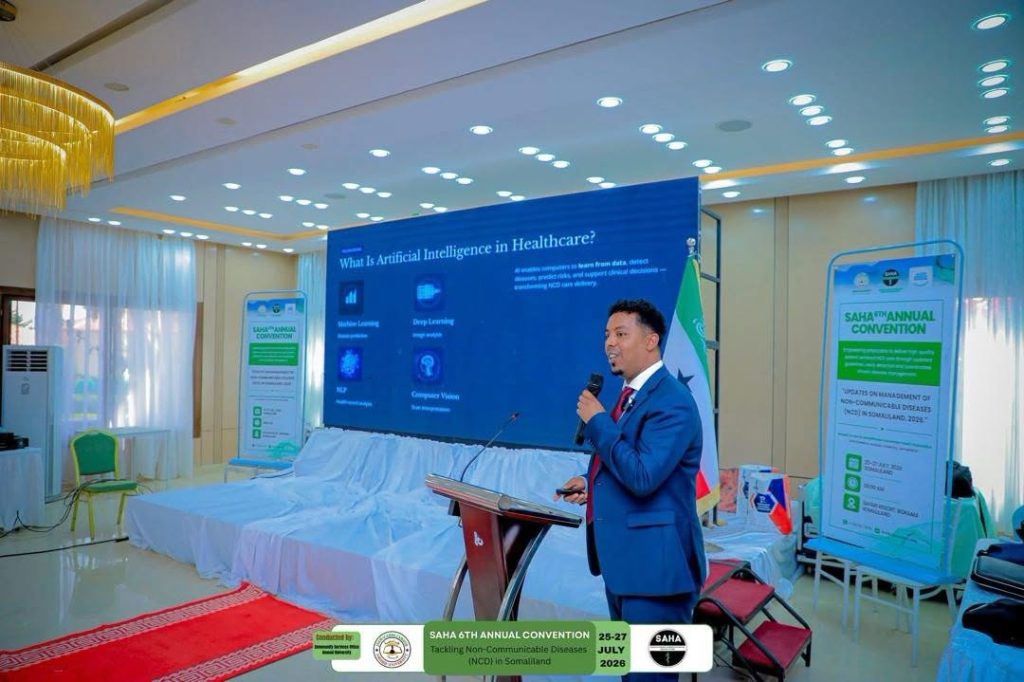
BORAMA, Somaliland – The third day of the SAHA 6th Annual Continuing Medical Education (CME) Convention 2026 brought a sharp focus on the future of healthcare, as Yusuf Hared, Director of the Center for Community Services at Amoud University and PhD Candidate in Care Sciences at Dalarna University, Sweden, delivered a forward-looking presentation on the transformative role of Artificial Intelligence (AI) in addressing the growing burden of Non-Communicable Diseases (NCDs).
The session, titled “How Artificial Intelligence is Transforming Health: A Focus on Non-Communicable Diseases,” provided an in-depth exploration of how emerging technologies can reshape prevention, diagnosis, treatment, and long-term care for chronic conditions such as cardiovascular disease, cancer, diabetes, and chronic respiratory diseases.
Addressing the Global NCD Burden
Opening with stark data, Hared reminded the audience that NCDs account for 74% of all global deaths, placing immense strain on healthcare systems worldwide. He argued that the scale of the crisis requires innovative, scalable solutions and that AI is uniquely positioned to fill that gap.
“AI is not a distant future – it is already here, and it is already transforming how we detect, treat, and monitor chronic diseases,” Hared stated. “The question is not whether we will adopt AI, but how quickly and equitably we can integrate it into our healthcare systems, particularly in resource-limited settings like Somaliland.”
AI Across the Entire NCD Care Pathway
Hared presented a comprehensive framework demonstrating how AI supports every stage of the NCD care continuum from prevention and early detection to diagnosis, treatment, remote monitoring, and long-term care.
He highlighted specific applications:
- Early Detection: AI-powered ECG interpretation for heart disease, mammography and CT-based detection for cancer, and retinal screening for diabetic retinopathy.
- Personalised Treatment: AI systems that integrate genetics, medical history, lifestyle, and laboratory data to deliver customised treatment plans.
- Wearable Technology: Continuous glucose monitors, smartwatches, and blood pressure devices that enable real-time, remote patient monitoring and early intervention.
Real-World Evidence and Regional Relevance
Hared reinforced his presentation with evidence from recent studies:
- A 2025 meta-analysis of 315 studies reported pooled sensitivity and specificity of 0.86 for AI in lung cancer detection.
- The Machineborne Early Diabetic Warning And Control System (MEDWACS) AI system achieved a Receiver Operating Characteristic – Area Under the Curve (ROCAUC) of 0.804 in predicting diabetes risk across diverse populations.
- Wearable technologies have demonstrated fall detection sensitivity of 92% and have reduced false alarms by 35% in clinical settings.
He also emphasised the relevance of AI for low-resource settings, citing research showing that edge-deployable machine learning models can achieve 89% accuracy in early diabetes detection making them suitable for contexts like Somaliland, where healthcare infrastructure is limited but mobile technology is increasingly accessible.
Benefits, Challenges, and Ethical Imperatives
Hared acknowledged the significant benefits of AI integration: earlier diagnosis, higher accuracy, personalised care, reduced hospital admissions, and lower healthcare costs.
However, he did not shy away from the challenges:
- Data privacy and cybersecurity
- Algorithm bias
- High implementation costs
- Unequal access, particularly in low-income regions
- The need for regulatory alignment and ethical safeguards
He stressed that human oversight, transparency, and accountability must remain central to AI adoption in healthcare. “AI is not replacing healthcare professionals – it is empowering them to deliver smarter, faster, and more personalised care,” he concluded.
A Vision for the Future
Looking ahead, Hared outlined emerging trends that will shape the future of AI in healthcare, including digital twins, AI-powered virtual assistants, predictive population health, and AI-assisted drug discovery. He called for collaboration between clinicians, policymakers, and AI experts to ensure responsible and equitable implementation.
Strengthening Digital Health Capacity in Somaliland
The session sparked animated discussion among participants, who reflected on the local relevance of AI technologies for NCD management in Somaliland’s context. The session was part of SAHA Convention and organised by the Amoud University Center for Community Services as part of the university’s broader commitment to advancing health innovation, research, and professional development.
As healthcare systems in the Horn of Africa face growing NCD burdens, sessions like this equip local professionals with the knowledge and vision to leverage cutting-edge technology in the fight against chronic disease.
Event Summary:
- Event: SAHA 6th Annual CME convention 2026
- Key Speaker: Yusuf Hared, Director, Center for Community Services, Smoud University
- Location: Safari, Borama
- Organiser: Center for Community Services, Amoud University